
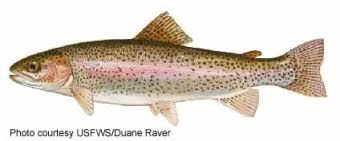
Rainbow trout – Oncorhynchus mykiss
The rainbow trout has a head and body shape similar to that of a brown trout. Adult males also resemble other male trout with their upturned lower jaw. The body color adapts to the color of the environment to some extent, it can be darker or very light. Otherwise, the back is darker, gray to brownish green, the sides are lighter, and the belly is light gray to whitish. A red stripe runs along the flank from head to tail, which becomes beautifully iridescent during spawning, hence its English name rainbow trout, which means rainbow trout. It has tiny black spots scattered all over its body and all fins. The rainbow trout reaches sexual maturity at 2-3 years of age…
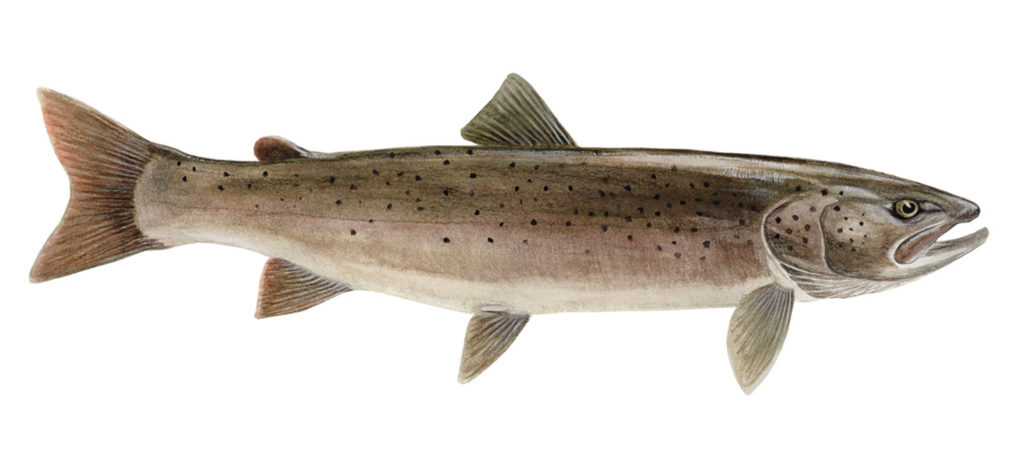
Pike – Hucho hucho
The pike is our largest fish from the trout family, with a distinctly spindle-shaped body, a large head, and a very large snout with strong teeth. The back is grayish-green to grayish-brown, the flanks are lighter with a coppery shimmer, which becomes even more pronounced in males during spawning and in older individuals. The belly is whitish to light silvery-gray. The fins are light, dirty white or grayish. The back and flanks are dotted with rare and irregular black spots. The pike reaches sexual maturity in the 4th-5th year at a size of about 65-70 cm. It spawns from October to mid-February….
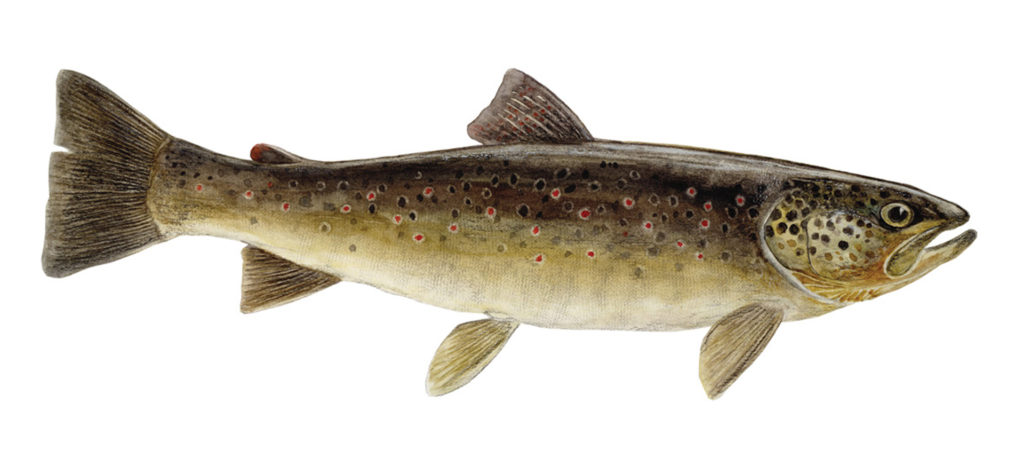
Brown trout – Salmo trutta m. fario
The brown trout has a spindle-shaped, laterally slightly compressed body. The head is medium-sized, the snout extends back beyond the posterior edge of the eye, and the mouth is terminal. In sexually mature males, the lower jaw is hooked and curved upwards. There are teeth on the rake, as well as in the jaws, tongue and palate. The back is greenish to brownish, sometimes almost black, the flanks are lighter, yellow to golden yellow, the belly is whitish. It has black spots on the back, bordered with a light edge, and on the flanks the spots are also red and bordered with white or light blue. Young trout have 6-9 transverse darker stripes on the flanks. …
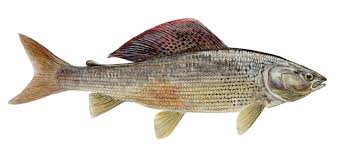
Grayling – Thymallus thymallus
Grayling is a rather uncharacteristic fish for trout. It has a strongly flattened body and a convex back with a characteristic, iridescent, long and high dorsal fin. The head of grayling is small with a small protruding mouth that has soft lips. The body is orange-silver in color, and it is covered with fairly large scales that are arranged in straight rows. The front part of the body of grayling has smaller and less contrasting spots. The back of these fish is greenish-brown in color, and the belly is silvery yellow. On average, grayling grows between 25 and 35 cm, but exceptionally they can reach up to 63 cm and 6.7 kg. ….
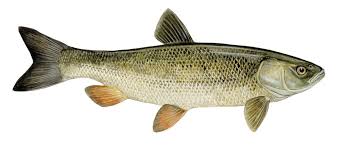
Chub – Leuciscus cephalus cephalus
The chub has a spindle-shaped, cylindrical body, covered with large, black-edged scales. The head is flat, with a wide forehead and a large mouth, which is terminal and has fleshy lips. The mouth opening reaches the last nostril. The pharyngeal teeth are in two rows. The chub has a gray-green back, the sides are silver to golden yellow, and the belly is white. The dorsal and caudal fins are dark, the pectoral fins are dark with a reddish tint, and the pelvic and anal fins are reddish. The chub is characterized by a convex anal fin, which immediately distinguishes it from the chub. …