The rainbow – Oncorhynchus mykiss
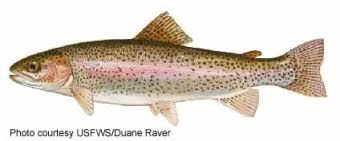
The rainbow trout has a head and body shape similar to that of a brown trout. Adult males also resemble other male trout with their upturned lower jaw. The body color adapts to the color of the environment to some extent, it can be darker or very light. Otherwise, the back is darker, gray to brownish green, the sides are lighter, and the belly is light gray to whitish. A red stripe runs along the flank from head to tail, which becomes beautifully iridescent during spawning, hence its English name rainbow trout, which means rainbow trout. It has tiny black spots scattered all over its body and all fins. The rainbow trout reaches sexual maturity at 2-3 years of age. In its homeland, it migrates from the sea to freshwater during spawning or spends its entire life in freshwater. In Slovenia, however, where it reproduces naturally, it remains its entire life and does not migrate. In nature, it spawns from February to April, and in fish farms, it spawns in December or even earlier (October). The female lays 1600-2000 eggs per kilogram of body weight. The eggs are large, measuring about 4.5 mm in diameter. It feeds like other trout species, i.e. on small aquatic invertebrates, insects flying above the water, and larger and smaller fish. In its natural homeland, it lives in schools in larger pools and deeper parts of watercourses. In our country, it inhabits the same waters as brown trout, but it can withstand higher temperatures and is not an indigenous fish species.
Distribution:
The original homeland of the rainbow trout is North America. It lives in rivers that flow into the Pacific Ocean. Since its settlement in Europe, where it was settled from California in 1880, it has spread throughout all European watercourses. It also inhabits almost all watercourses in Slovenia, where it was brought in 1890, and its population is artificially maintained by fishermen who constantly stock it for sport fishing. It also reproduces in many waters where fishermen invest it. So far, it does not pose any danger or competition to other fish anywhere.
Economy:
Due to its rapid growth, it is raised in fish farms throughout Slovenia, both for investment in sport fishing waters and for human consumption. Among all trout species, it is the most economically important in our country. It is interesting for sport fishing mainly because it is very voracious and catches at any time of day, and it is not picky about bait.