
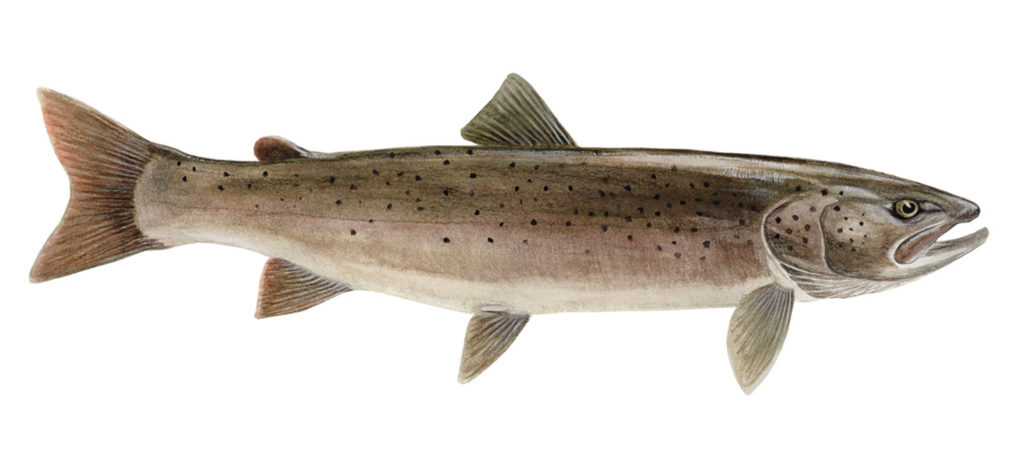
The pike – Hucho hucho
The pike is our largest fish from the trout family, with a distinctly spindle-shaped body, a large head, and a very large snout with strong teeth. The back is grayish-green to grayish-brown, the flanks are lighter with a coppery shimmer, which becomes even more pronounced in males during spawning and in older individuals. The belly is whitish to light silvery-gray. The fins are light, dirty white or grayish. The back and flanks are dotted with rare and irregular black spots. The pike reaches sexual maturity in the 4th-5th year at a size of about 65-70 cm. It spawns from October to mid-February. During spawning, sexually mature individuals travel to smaller tributaries, where they spawn in pairs on gravelly bottoms. The female digs a pit with her caudal fin, where she deposits her eggs. Adult pike are piscivorous, while young ones feed on permanent invertebrates and the fry of other fish, especially wrasses. Where there are enough mouths, there used to be a lot of sculpins, but today this situation has been destroyed due to numerous negative influences. The sculpin already inhabits the areas of watercourses where the trout zone ends and the grayling zone begins, and in this zone it is increasingly common, probably due to the deterioration of living conditions in other parts of the watercourses. Young sculpins live for some time in smaller tributaries, and as they grow, they migrate to larger watercourses where their parents live.
Distribution:
The settlement area of the sculpin is the Danube basin. In the last 20-30 years, it has been introduced into some watercourses in Western Europe, but without success. It inhabits the Sava Bohinjka and Sava, Savinja, Ljubljanica with its tributaries, Sora, Mirna, Drava, Krka, Kolpa and their tributaries, and in the 1960s it completely disappeared from the Mura River.
Threat:
In past centuries, the pike was one of the most interesting game fish, which is why it was already overfished in the past. In addition, dams in the upper parts of rivers, where the pike used to be most common, also have a negative impact. Deterioration in water quality has a greater negative impact on the pike than on all other trout species.
The most appropriate protection measure is to protect the part of the river where adult animals would live undisturbed, and to protect spawning grounds. The pike is disturbed during spawning by even the slightest movement along the water. Where protection of the biotope is not possible, intensive investment in artificially bred fish is necessary. Breeding is very successful in our country, as well as in other countries of its range. An important protection measure is also the hunting season, the minimum hunting size and a limited number of captured specimens and fishing methods. The pike is a very interesting sport fishing fish.