
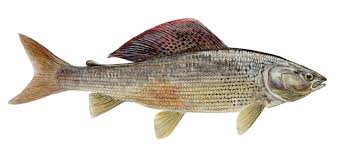
Grayling – Thymallus thymallus
Grayling is a rather uncharacteristic fish for trout. It has a strongly flattened body and a convex back with a characteristic, iridescent, long and high dorsal fin. The head of grayling is small with a small protruding mouth that has soft lips. The body is orange-silver in color, and it is covered with fairly large scales that are arranged in straight rows. The front part of the body of grayling has smaller and less contrasting spots. The back of these fish is greenish-brown in color, and the belly is silvery yellow. On average, grayling grows between 25 and 35 cm, but exceptionally they can reach up to 63 cm and 6.7 kg. They become sexually mature in their third or fourth year of age, and spawn in March and April on the gravel bottom. The male digs a hole in the sand with his tail fin, where the female lays 3,000 to 6,000, and exceptionally up to 10,000 eggs. The main food of graylings is aquatic insects and insects that it picks up from the water surface, as well as various bottom invertebrates, eggs and the offspring of other fish. Grayling lives in clean and cold parts of rivers where the current is fast, and it is also found in cold mountain lakes where the water temperature does not exceed 20° C in summer. There must also be enough oxygen in the water for grayling to thrive. The river belt that begins after the trout belt is also named after grayling.
Distribution:
It is widespread in England, southern Scandinavia, in rivers that flow into the North Sea, in the upper tributaries of the Volga. In Central Europe, it is widespread in some rivers in France, Germany, northern Italy and some rivers of the Danube basin.
Threat:
In Slovenia, it can be found in the upper reaches of almost all rivers, and in recent decades it has disappeared only from the Mura. The only reason for a fairly stable grayling population is the massive release of juveniles raised in fish farms back into rivers. In its natural environment, it is most threatened by pollution and regulation of watercourses. It is an extremely interesting fish for sport fishing, especially for fly fishing, and wherever hunting is permitted, it is protected by a hunting season, a minimum catch size, fishing method and a limited number of fish caught.