
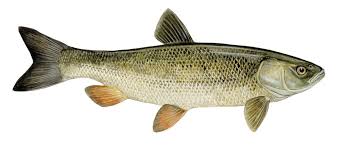
Chub – Leuciscus cephalus cephalus
The chub has a spindle-shaped, cylindrical body, covered with large, black-edged scales. The head is flat, with a wide forehead and a large mouth, which is terminal and has fleshy lips. The mouth opening reaches the last nostril. The pharyngeal teeth are in two rows. The chub has a gray-green back, the sides are silver to golden yellow, and the belly is white. The dorsal and caudal fins are dark, the pectoral fins are dark with a reddish tint, and the pelvic and anal fins are reddish. The chub is characterized by a convex anal fin, which immediately distinguishes it from the chub. The chub grows on average 20-40 cm and reaches an age of 7-10 years. The oldest caught specimens that have been registered were also 15-20 years old. The largest caught specimens are 60 cm long and weigh 4 kg. It becomes sexually mature in 3-4 years of age. Spawning occurs from April to June. During this time, males develop spawning warts on their heads and bodies. They choose shallow gravel areas with strong currents for spawning. The female lays 100,000-200,000 eggs (45,000 eggs/kg), which stick to rocks, pieces of wood or plants and hatch after a week. The chub feeds on aquatic insects and larvae, mollusks, fish eggs and sometimes plants. Adult chubs are also piscivorous. They live in schools in flowing waters with very varied bottoms and banks and with strong currents. They are also often found in larger standing waters, e.g. in Lake Bohinj and Lake Cerknica. Along the Finnish coast, they even enter brackish water. In winter, they migrate to deeper parts of rivers and lakes, and in spring they return to shallower streams.
Distribution:
It is widespread in the waters of all of Europe, except in northern Scotland, Ireland, Scandinavia, in the Vardar and Adriatic basins. Its range extends across the Black Sea to the western shores of the Caspian Sea. In Slovenia, it is widely distributed in all rivers of the Danube basin. It extends into the zone of trout, grayling, barbel and plaice.
Threat:
The chub is sensitive to organic pollution and is threatened primarily where spawning grounds are destroyed due to pollution or regulations. There are no suitable gravel beds in regulated waters. The protection of the chub therefore only lies in the protection of the biotope or spawning grounds. It is protected only by hunting restrictions and hunting permits.