
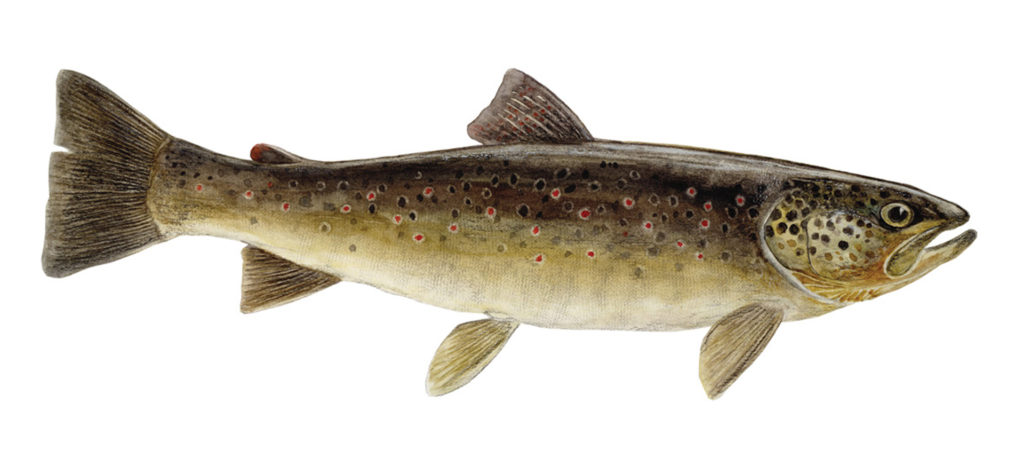
Brown trout – Salmo trutta m. fario
The brown trout has a spindle-shaped, laterally slightly compressed body. The head is medium-sized, the snout extends back beyond the posterior edge of the eye, and the mouth is terminal. In sexually mature males, the lower jaw is hooked and curved upwards. There are teeth on the rake, as well as in the jaws, tongue and palate. The back is greenish to brownish, sometimes almost black, the flanks are lighter, yellow to golden yellow, the belly is whitish. It has black spots on the back, bordered with a light edge, and on the flanks the spots are also red and bordered with white or light blue. Young trout have 6-9 transverse darker stripes on the flanks. The edge of the caudal fin is notched in younger fish, but straight in older ones. Brown trout reach sexual maturity in the 2nd, usually in the 3rd year of age. It spawns from October to February in gravelly areas of streams. The female lays 1000-3000 rather large eggs. It grows up to 50 cm, rare specimens are up to 70 cm. The size of the individuals depends mainly on the available amount of food and the temperature of the water. Adult fish feed mainly on invertebrates and aerial food (insects flying above the water) and partly on fish. Brown trout inhabits watercourses from fast-flowing mountain streams to wide lowland river courses.
Distribution:
Brown trout is the most numerous and most widespread native species of trout in Europe. It is also inhabited in North America, other countries of the northern hemisphere and in Central Africa. It lives in rivers and lakes up to an altitude of 2500 m, exceptionally even higher. It inhabits all Slovenian watercourses of the Danube basin from large rivers to the smallest streams. In the 20th century, it was also settled in the Soča river basin.
Threat:
The decline in the brown trout population is observed only locally, in waters where there are frequent deaths and constant pollution, or where rivers are regulated. A prerequisite for the existence of the species is a habitat for all stages of development, such as pools, hiding places along the banks, clean tributaries for spawning, etc. The brown trout population is negatively affected by such interventions that change the water level in the rivers, so that the water even dries up in winter and becomes too hot in summer. It is protected by a hunting season, a hunting limit, the permitted number of prey items and the method of fishing. The most effective protection is successful artificial breeding, as the current situation is the result of very intensive population growth. Brown trout is one of the most popular fish for sport fishing.